
The Quiet Strength of Silvaner
 I like grape varieties that do not fully explain themselves with the first sip.
Savagnin, Chenin Blanc, Aligoté and, increasingly, Silvaner. At first glance they have little in common. Different regions, different aromatic profiles, different traditions in the cellar. And yet varieties like these have experienced a remarkable revival in recent years.
Their strength often lies somewhere other than where wine is easiest to access: in the fruit. They become more interesting through texture, phenolics, tension and the way they can express a sense of place.
With Silvaner, I find this particularly compelling.
For this article, I tasted Richard Östreicher’s Silvaner Maria, Carsten Saalwächter’s Silvaner Grauer Stein and KRAEMER’s Silvaner Steillage Alte Reben. Three very different wines that show just how far Silvaner has moved beyond its old image.
They also led me to a thought I had not expected:
Can Silvaner sometimes express its site even more clearly than Riesling?
In Germany, that borders on lèse-majesté.
Silvaner was never the wrong grape variety
The usual story goes that Silvaner was underestimated for decades until ambitious growers rediscovered its potential.
That is too simple for me.
Silvaner was hardly some obscure, marginal grape. Its cultivation in Castell is documented as early as 1659. It later became one of Germany’s most important varieties and remained the country’s most widely planted grape until the 1970s.
There were practical reasons for this. Silvaner crops reliably and is capable of high yields. In a wine industry where volume and dependable supply mattered more than low yields or the expression of individual sites, that was a considerable advantage.
Later, that became part of the problem.
At high yields, an already aromatically restrained variety can quickly lose what makes it interesting: substance, extract, phenolic grip and length. In the worst case, what remains is the kind of Silvaner that shaped the variety’s image for decades: mild, neutral, correct and fairly quickly forgotten.
Yet the other side of Silvaner had always been there. Würzburger Stein, Escherndorfer Lump and other great Franconian sites did not acquire their reputations only with today’s discussion of terroir.
Silvaner did not suddenly have to become a great grape variety. We had simply grown accustomed to mistaking its weakest expression for its true character.
Perhaps it is our idea of quality that has changed most
For me, that shift is more interesting than the story of a simple rediscovery.
Silvaner is not alone in this. Aligoté, Savagnin and Chenin Blanc are also seen differently today than they were a few decades ago. Not because the varieties themselves have somehow changed, but because many wine drinkers now pay attention to different things.
Part of that shift concerns which qualities we consider important in a wine in the first place.
For a long time, wine was explained primarily through varietal character and aroma. That still works extremely well: Riesling smells different from Sauvignon Blanc, and Sauvignon Blanc different from Chardonnay. Varietal character therefore remains, quite rightly, an important framework when tasting.
It simply does not explain everything.
The more deeply I engage with wine, the less I find the question “What does this wine smell and taste of?” sufficient on its own.
I am at least as interested in:
Why does it smell and taste the way it does?
That changes the focus. Primary fruit becomes slightly less important, while texture, phenolics, the shape of the acidity, extract and balance move closer to the centre. Length on its own also tells us little. What matters is what remains after swallowing and how the wine develops as it does so.
This is where Silvaner starts to become interesting for me.
Silvaner has to be understood on the palate
Great Silvaner reveals itself to me only partly through the nose.
Of course, one can find apple, pear, herbs, yellow fruit or floral notes. But with the best Silvaners, aroma is rarely what really holds my attention.
The more important information is often on the palate.
How much drive does the wine have? How well integrated are the phenolics? Does the slight bitterness give definition, or does it feel coarse? Does the wine remain taut despite its substance? And what carries it through the finish?
Compared with Riesling, Silvaner’s acidity is usually less dominant in sensory terms. One of the elements through which Riesling can build a great deal of tension is therefore less pronounced here.
In Silvaner, extract, acidity, phenolics and mouthfeel have to work more closely together. Picked too early, it can seem thin and green; at excessive ripeness, it can easily lose definition. High yields take away substance, while too much extraction can turn phenolic grip into hardness.
When the balance is right, the wine develops a tension of its own, driven more by structure and texture than by acid pressure and primary fruit.
Three Silvaners, three interpretations
That is precisely why I found the three wines for this article so revealing.
Richard Östreicher’s Silvaner Maria comes from a roughly fifty-year-old vineyard in the Volkacher Ratsherr. The vines grow on Muschelkalk and yields are very low. The starting point alone is far removed from the old idea of Silvaner as a high-yielding, easy-going variety.
Carsten Saalwächter’s Grauer Stein takes a different route: a small parcel in Ingelheim, almost fifty-year-old vines on lean grey limestone, a short period of skin contact and ageing in used wood. Alongside variety and site, there are therefore other factors at work here that can clearly influence texture and phenolic structure.
KRAEMER’s Silvaner Steillage Alte Reben shifts the emphasis still further towards phenolic and tactile structure. Fruit is not the centre of the wine; what happens on the palate is more interesting.
Three Silvaners, but very different ideas of what the variety can do.
Tasting them made me realise that I had spent a long time approaching Silvaner with the wrong coordinates. I looked first for fruit and acidity. It became more interesting once I paid closer attention to texture, phenolics and the way the wine moved across the palate.
That, however, raises a more difficult question: if Silvaner can show such differences through structure and mouthfeel, how much of that is genuinely down to site?
Can you really taste the soil?
With Silvaner, it does not take long before people start talking about it as an ideal “translator of terroir”. Muschelkalk is said to taste saline and chalky, Keuper spicy and earthy, Buntsandstein lean and cool.
I almost like these classifications too much.
Because of course we do not taste Muschelkalk itself. Minerals from the rock do not travel into the grape and later into the glass as a flavour copy of the soil.
What we perceive as site expression is more complicated.
Soil structure and water availability influence vine development. Aspect, elevation and mesoclimate affect temperature and the course of ripening. Vine age, yield, vineyard management, vintage and picking date all enter the picture as well. Even in the vineyard, many factors are acting at the same time.
That is why I have become cautious about statements such as “this wine tastes of limestone”.
I am more interested in why a wine has a particular texture, a particular shape to its acidity or a certain phenolic grip, and what part the site may have played in creating those qualities.
That is less catchy than “limestone tastes saline”.
But it is closer to what we actually know.
We never taste site in isolation from winemaking
The differences between the three wines I tasted cannot simply be attributed to the vineyard either. Vinification has a considerable effect on how we perceive them.
Skin contact increases phenolic extraction. Extended lees ageing changes texture and mouthfeel. Ageing in large or used wooden vessels can allow slow oxygen ingress without necessarily imposing dominant oak flavours. A reductive character can also push fruit aromatically into the background and draw our attention more strongly towards structure.
All of this influences what we later interpret as site expression.
Spontaneous fermentation, reduction, turbidity or extended lees ageing are not terroir. They are tools. They can bring differences between sites into sharper focus, or overlay them with a strong cellar signature.
For me, it becomes interesting when the cellar work is no longer what commands attention, and the wine does.
And then there is Riesling
Which brings me back to my slightly dangerous thesis:
Silvaner can sometimes transmit a sense of place more directly than Riesling.
Riesling remains, for me, one of the world’s great white grape varieties. Its combination of high acidity, aromatic precision, enormous ageing potential and the ability to achieve great intensity even at moderate alcohol is extraordinary.
But Riesling also has a very distinct voice of its own. Even blind, the variety is often surprisingly easy to recognise.
Silvaner usually brings less pronounced varietal primary aroma. That can be an advantage, because differences in texture, ripeness, phenolics and winemaking are given more room.
Of course, that does not automatically make it the better vehicle for site expression. Aromatic restraint can just as easily taste simply boring.
And an average Riesling can still be appealing thanks to its acid tension and aromatics. With an average Silvaner, there is often less to hold on to.
In the best wines, however, that disadvantage can turn into the opposite. Precisely because Silvaner is less aromatically dominant, I often perceive differences in structure, texture and site more clearly.
The quiet strength
The longer I have spent with Silvaner, the less convinced I am by the story of the “rediscovered grape variety”. Its most interesting qualities were there all along: restrained primary aromatics, acidity that is usually less dominant, and the ability to build tension through texture, extract and phenolics. What has changed most is the way we look at those qualities. What once seemed unspectacular now fits remarkably well with an understanding of wine that places greater value on individuality and sense of place.
That is exactly why the best Silvaners interest me so much today. They do not need to impress through aromatic intensity. Their quality reveals itself on the palate and in how clearly a wine can express where it comes from. Perhaps that is Silvaner’s real strength: its varietal character is quiet enough to leave room for the site.
For me, that is exactly the strength of Silvaner.
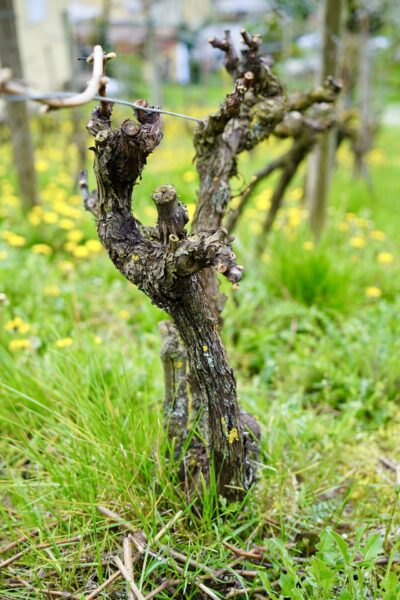
My thanks to Weingut Zehnthof Luckert for kindly providing the photograph.