
What a Rancher, a Zen Farmer and a Forester Can Teach Us About Wine
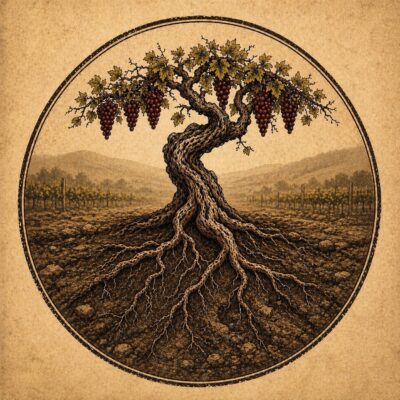 Reading Wine from the Soil
Not every shift in our understanding of wine begins in the glass. Sometimes its origin lies elsewhere, in an unexpected place: an audiobook on soil narrated by an American rancher.
Perhaps this is because many of the questions we ask about wine cannot be fully answered by wine literature alone. To understand how a wine is made, you have to step beyond your own discipline and look for answers where you would not expect to find them.
For me, that shift in perspective did not come from a wine book, but from the audiobook Dirt to Soil by Gabe Brown. As I listened, it was not so much the complexity of soil that struck me, but rather my own simplification of it: I had mentally separated soil structure, nutrients and water dynamics, even though in practice they are inseparable.
Brown does not describe soil as a substrate, but as a living system, shaped by microorganisms, root activity and organic matter. The idea seems simple at first, but its implications are far-reaching. What we separate analytically remains in practice an interconnected whole.
This is where the way we structure our knowledge about wine reaches its limits. The Wine & Spirit Education Trust Diploma deliberately separates aspects such as soil structure, nutrient supply and water management. Pedagogically, this makes sense. It becomes problematic only when we mistake this separation for reality.
Mycorrhiza, root growth and humus formation thus appear less as isolated factors and more as central processes, interlinked through complex interactions, and as part of what we describe as terroir.
System, Not Levers
It is precisely within these interactions that the key distinction lies: between a functioning whole and a mere sum of individual components.
Approaches in regenerative agriculture, particularly those discussed by David R. Montgomery, consistently frame soil in these terms, not as a substrate but as an interplay of physical, chemical and biological processes that influence and reinforce one another.
Mycorrhiza offers a particularly vivid example. The bidirectional exchange between fungi and plants makes clear that nutrient uptake cannot be understood in isolation, but depends on functioning interactions.
This perspective stands in contrast to an approach in which individual factors are treated separately. In education, this is often necessary.
Interventions in such a system never act in isolation. Mineral fertilisation, for instance, may create short-term availability, but in doing so also alters the microbial and chemical environment in which those nutrients are taken up.
The physical properties of the soil do not contradict this view; they are part of the same whole. Soil structure emerges through interaction with biological activity and, at the same time, determines the conditions under which these processes can operate. It governs how water is stored, how air circulates, and how deeply roots can penetrate.
Stable aggregation with sufficient porosity allows for root growth, water infiltration and gas exchange, enabling these processes to function together. Under such conditions, water becomes more evenly available throughout the growing season. What matters is not so much the absolute quantity, but the continuity of supply within the root zone and it is this continuity that shapes the vine’s stress response.
A look at practice illustrates how relevant this is. In Tuscany, for example, Sangiovese reacts sensitively to differences in water availability. On shallow, more freely draining soils such as Galestro, water supply may become uneven, leading to heterogeneous phenolic ripeness. Sites with deeper rooting potential and greater water retention, such as those on Alberese, tend to provide a more even supply over the growing season.
These differences do not arise in isolation. Weather patterns, yield levels and vineyard management all play a role and can overlay the influence of the soil. The effects described are therefore not equally visible in every vintage.
When they do appear, they rarely show up in individual metrics, but rather in the structure of the wine. Tannins may seem finer-grained and more integrated, while uneven stress can result in more angular phenolics, a distinction that is difficult to fully explain without considering root zone dynamics and water availability.
At the same time, practice shows that more input-driven approaches can also yield convincing results. Precise fertilisation, irrigation and yield management allow conditions to be controlled and risks reduced.
Yet this stabilisation comes at a cost. The more conditions are imposed from the outside, the less differences between sites come to the fore. Origin is not erased, but it recedes behind intervention.
Similar tensions can be observed in other areas of agriculture. Michael Pollan describes in The Omnivore’s Dilemma how different production systems generate their own internal logics and trade-offs.
The difference lies less in the outcome of individual years than in how consistently those outcomes can be reproduced over time and to what extent they depend on external inputs.
From System to Vineyard
This perspective finds its most consistent expression in The One-Straw Revolution by Masanobu Fukuoka.
Fukuoka advocates an approach that minimises intervention and, as far as possible, allows the system to regulate itself. In this form, it does not readily translate to quality-focused viticulture. Vine, site and quality objectives are simply too different.
Yet certain ideas can be carried into the vineyard: reduced soil disturbance, permanent cover crops, and a restrained approach to interventions in both soil and root zone all aim to preserve the functional integrity of the soil rather than replace it with short-term measures.
What matters here is less the method than the perspective it opens up: Which interventions are necessary, and which arise out of habit?
The focus shifts accordingly to how well the system functions. How stable is the root zone? How even is water availability over the course of the growing season?
The crucial question is not whether to intervene, but whether an intervention supports the existing system or replaces it.
Analogy and Its Limits
The Hidden Life of Trees by Peter Wohlleben introduces a perspective that, at first glance, seems far removed from wine. At its core is the idea that plants do not exist in isolation, but are embedded in functional networks through roots and microorganisms. While many of these observations are treated more cautiously in the scientific literature, they point to something simple: plants are part of a system, not merely individuals.
Forests are not vineyards. That is where the analogy reaches its limit. What can be compared, however, is the soil in which both exist: a network of roots, microorganisms and physical structure.
In viticulture, vines are often considered as individual plants, whether in terms of yield, vigour or water status. Seen in this context, that perspective shifts. The vine appears less as an isolated unit and more as part of a functional system within the root zone.
Studies, including those at Geisenheim University, highlight not only the importance of the root zone but also its role as a buffer. Variations in rainfall or temperature do not affect the vine directly or in a simple linear way; they are absorbed, stored and released over time by the soil.
The root zone thus determines when climatic conditions take effect, and in what form they reach the vine. What matters is not only how much water is available, but when it becomes accessible.
Two vintages with similar weather patterns can therefore result in markedly different wines if the timing of water availability in the root zone differs. Whether water stress occurs earlier or later in the growing season influences the vine’s physiological development, particularly the balance between vegetative growth and ripening, and ultimately the structure and maturity of the wine.
The vine responds to climate. Its physiological response, however, is shaped by the conditions within the root zone
Perception Is Not a Metric
Gastrophysics by Charles Spence shifts the focus from the wine to the taster. Perception does not arise from stimuli alone, but from how they are interpreted in conjunction with expectation.
Within the structured tasting framework of the Wine & Spirit Education Trust, it is clear that expectations, such as knowledge of origin, grape variety or price, can influence both the perception of intensity and the assessment of balance.
In the Diploma, the aim is to explain why a wine tastes the way it does. At the same time, we are working with a system that structures perception rather than making it objective.
The language we use to describe wine is not neutral. Terms such as balance or intensity appear precise, yet remain interpretive.
What we describe in the glass as structure, tension or ripeness is the result of processes that lie beyond what we can directly perceive. Tasting cannot make these processes visible; it can only describe their outcome.
Only when set alongside the processes in the soil do these descriptions begin to gain explanatory power. Sensory analysis remains indispensable, but it becomes meaningful only when connected to the conditions under which a wine is made.
From Glass to Soil
Tasting describes the result in the glass, not the conditions under which a wine is made.
What we describe as terroir often only becomes clear when soil conditions remain consistent over time, allowing the vine to respond with nuance. This is, by design, a partial view. Climate, topography and viticulture also play their part, but here they recede in favour of the soil.
Since I began to take the complexity of the soil more seriously, I read vineyards with greater nuance and see wines as the expression of processes unfolding in the soil over time.
Further Reflections: Books That Shaped This Essay
Dirt to Soil – Gabe Brown
Growing a Revolution – David R. Montgomery
The One-Straw Revolution – Masanobu Fukuoka
The Hidden Life of Trees – Peter Wohlleben
Gastrophysics – Charles Spence
The Omnivore’s Dilemma – Michael Pollan