
Sherry and Oysters – A Quiet Approach
Why Fino from Jerez can be a surprisingly precise alternative to Chablis and Muscadet
The first oyster with a Fino is a subtly disorienting moment. Not because the pairing does not work – but because it works differently than expected.
There are combinations that seem so self-evident that we hardly question them. Oyster and Chablis. Muscadet sur lie from the Loire. Or Blanc de Blancs from Champagne. These are familiar reflexes – not always conscious choices. And that is precisely where the problem with many pairing ideas begins: they are repeated, not reconsidered.
The encounter with a Gillardeau oyster and a Fino from Bodegas Tradición did not arise from culinary staging, but from a quiet experiment at home. Without expectation. Without the need to impress. With the lingering question of whether we sometimes think about pairings too loudly.
Why we instinctively reach for Chablis – and what may be lost
Chablis is widely regarded as the classic answer to oysters. Its acidity and saline freshness draw a clear line, structure the palate and preserve the oyster’s iodine character. Muscadet and Champagne follow a similar logic – adding texture through lees ageing or lift through carbonation, yet remaining within the same structural framework.
All three ultimately rely on the same idea: acidity as the solution. That is correct – but it is also too simple.
What happens if the axis shifts from acidity to flor? When citrus and chalk give way to acetaldehyde, almond and dry, savoury impressions? A Fino shifts the coordinates. It does not merely accompany the oyster; it reframes it – quietly.
The particular character of the Gillardeau oyster
The Gillardeau oyster occupies a distinctive place in the world of oysters. Originating from France’s Atlantic coast, particularly around Marennes-Oléron, it is now considered one of Europe’s most recognisable branded oysters. Its reputation rests less on striking salinity than on texture: the flesh is firm, succulent and marked by a subtle, slightly nutty sweetness.
This balance makes it especially compelling at the table. While some oysters are defined by iodine and maritime intensity, Gillardeau tends towards greater fleshiness and a more nuanced aromatic depth. That is precisely what allows for pairings that move beyond acidity and freshness alone.
Gillardeau and Fino – a question of restraint
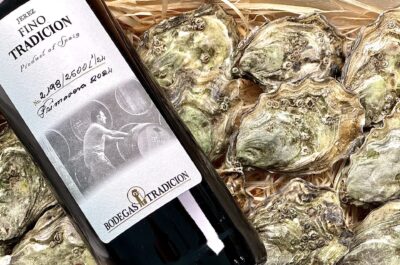 The Gillardeau oyster brings texture, a delicate sweetness and a precise maritime imprint. Classic white wines respond primarily with freshness. Fino behaves differently: under flor, fruit recedes, while dryness, fine almond-like bitterness and clear, almost austere contours define the wine.
The harmony here emerges less through aroma than through texture. The dry, almost chalky feel of the Fino picks up the oyster’s minerality, while its low glycerol impression reinforces that effect. At the same time, the wine’s saline impression – more an expression of dryness than actual salinity – intensifies the maritime character without overwhelming it.
This balance shows most clearly when the oysters are served lightly tempered and free of excess liquor.
A moment in the glass
In the glass was a Fino from Bodegas Tradición – Saca Primavera 2024.
Deep golden in colour. Even before the nose reaches the glass, notes of flor and green walnut emerge. With air, layers of salt, liquorice, green apple, lemon, almond and yeast follow – clearly delineated, without overlap.
The comparison is unavoidable: in its aromatic restraint, the wine shows an elegance more reminiscent of a fine Burgundy than of conventional expectations of Sherry. The characteristic acetaldehyde note of flor, formed during biological ageing, is fully integrated. Around ten years in solera lend additional depth and inner tension.
On the palate, a strict mineral axis with hints of chalk and salt sets the frame. Only from within this structure do further nuances unfold; the wine opens, expands. The finish is long, layered and tightly woven – nothing stands apart, everything interlocks.
With the Gillardeau oyster, a distinct dynamic begins to emerge. Its subtle nutty sweetness is not overshadowed by the Fino, but taken up and amplified. The combination is less about contrast than expected.
In such moments, Muscadet tends to emphasise the oyster’s maritime freshness, whereas Fino reveals its umami and nutty dimensions. This effect can be surprisingly intense and may not be immediately accessible to everyone. Yet that is precisely its appeal: a concentration of flavour that is not loud, but precise.
Temperature – the quietly decisive factor
Temperature determines balance. Served too cold, even a great Fino quickly loses its fine structure. Instead of subtle flor-derived aromas, bitter almond and hardness come to the fore – a sharpened perception of that fine, almond-like bitterness, which can render the oyster suddenly metallic.
At around 9 to 11°C, the wine finds its clearest form – cool enough for tension, yet not so cold that texture and flor aromatics recede. As it warms slightly in the glass, the Fino begins to speak.
An analytical aside: what makes Fino different
Chablis, Muscadet and Champagne rely on acidity, carbonation or autolysis – three distinct ways of creating freshness and structure. Fino follows a different path. Its character is shaped by biological ageing under flor, a layer of yeast that largely protects the wine from oxygen while producing compounds such as acetaldehyde. The result is a reduced aromatic profile with notes of almond, yeast and green walnut, combined with a pronounced dryness and a subtly saline impression.
Where classic pairings frame the oyster, Fino accompanies it almost invisibly. It acts less as a conversational partner than as a quiet amplifier.
This is not a hierarchy, but a different perspective.
A historical perspective
The connection between Sherry and seafood is not a modern pairing concept. In Jerez, Sanlúcar de Barrameda and El Puerto de Santa María – the three towns of the so-called Sherry Triangle – biologically aged wines have been part of everyday coastal cuisine for centuries.
In Sanlúcar in particular, the tradition of drinking Manzanilla with oysters, prawns and other seafood from the Gulf of Cádiz developed naturally. As early as the 19th century, British merchants and travellers described this combination as a local norm.
The explanation is simple: the dry structure and flor-driven aromatics of these wines align seamlessly with the Atlantic-influenced cuisine of Andalusia. What appears today as a refined pairing was originally simply regional practice.
Conclusion
The real question is not whether Sherry and oysters form a perfect pairing. What matters is how intense a combination can become when it appears, at first glance, so restrained.
Fino does not overshadow the oyster – it brings it into focus. Nutty depth, maritime imprint and the wine’s dry structure interlock, creating an intensity that arises less from contrast than from resonance.
This is not a spectacular effect, but a moment in which perception shifts – and the oyster suddenly tastes different from what one thought one understood.
That is precisely the strength of this combination: it does not seek to impress. It simply works – quietly, precisely and with surprising intensity.