
Kéknyelű – Beyond Yield
 Origin, intent and historical significance
Kéknyelű (phonetic: keek-nyell-ew) – literally “blue stalk”, a reference to the subtle bluish hue the petiole takes on in autumn – ranks among Hungary’s historically most esteemed grape varieties, long before systems of classification or appellation came into being. As early as 1799, the botanist and chemist Pál Kitaibel described Kéknyelű as one of the defining varieties of Badacsony.
Its historic heartland lies within the Balaton wine region, most notably in today’s PDOs Badacsony and Balaton-felvidék. Until the mid-19th century, Kéknyelű was typically part of mixed plantings; later, from a qualitative perspective, it emerged as one of the region’s leading varieties. Its reputation, however, was never built on quantity, but on a deliberate commitment to quality.
Kéknyelű is late ripening – traditionally harvested from mid to late October – naturally low yielding and prone to irregular fruit set. Typical yields rarely exceed 0.5–1 kg per vine. Compounding this is its distinctive floral biology: Kéknyelű is functionally female. While the flowers appear hermaphroditic, the stamens are sterile, making self-pollination impossible. Successful fertilisation therefore depends on pollen from neighbouring vines with fertile flowers, with wind acting as the primary vector.
In Badacsony, Budai Zöld has traditionally served as the main pollinator, alongside Rózsakő, a crossing of Kéknyelű and Budai Zöld. Crucially, effectiveness depends less on profuse flowering than on synchronised flowering periods; under suitable conditions, relatively few pollinator vines are sufficient.
From an ampelographic perspective, this biological peculiarity is widely regarded as an indicator of the variety’s considerable age. While most cultivated Vitis vinifera varieties became hermaphroditic through domestication, Kéknyelű retains a trait more commonly associated with wild vines.
For smallholders, the combination of late ripening, low yields and labour-intensive viticulture was rarely economically viable. Unsurprisingly, Kéknyelű became known locally as the “gentleman’s grape” – a variety for those who could afford uncertainty. It was never a wine of security, but a commitment to structure, patience and long horizons.
With the structural transformation of Hungarian viticulture in the 20th century – particularly from the 1960s onwards – Kéknyelű came under severe pressure. In a system increasingly geared towards predictability and volume, there was little room for a variety defined by low yields and qualitative ambition. Vineyard area collapsed from around 50 hectares in the 19th century to roughly five hectares by the 1960s, and to less than one hectare by around 1990. That the variety survived at all is largely due to Badacsony, where a small number of producers refused to abandon it.
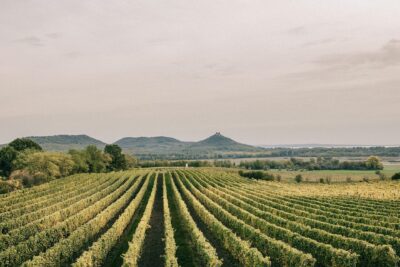 Today, approximately 45 hectares of Kéknyelű are once again under vine (as of 2024). This renewed interest is not a romantic rediscovery, but a rehabilitation. Kéknyelű is increasingly recognised for what it has always been: a variety defined by clear biological constraints, limited yields and pronounced structural potential. Its designation as a Hungarikum reflects this reassessment – not as a marketing device, but as a cultural and viticultural statement.
Why history becomes biology
Without this historical context, Kéknyelű might appear anomalous. With it, its attributes reveal themselves as logical consequences of biology rather than exception. To understand Kéknyelű, one must begin not in the cellar, but in the vineyard.
The biology behind the style – practice in Badacsony
Practical experience has nuanced several textbook assumptions. At Szászi Birtok, different planting systems have been trialled over more than a decade: both the traditional 50:50 ratio of Kéknyelű to Rózsakő and reduced proportions of the pollinator variety (three rows of Kéknyelű to one of Rózsakő). No significant differences in yield levels or yield stability have been observed, suggesting that under favourable site conditions, a lower proportion of pollinator vines can suffice.
In organic viticulture, however, the main challenges are shifting. While pollination itself is manageable, vine health has become increasingly critical. Flavescence dorée, transmitted by the American grapevine leafhopper (Scaphoideus titanus), represents a growing threat. Field observations indicate that Kéknyelű may be more susceptible to this disease than other varieties – adding another layer of complexity to organic management.
The variety also shows relatively poor tolerance to prolonged drought stress. In hot, dry seasons, sugar accumulation can proceed more slowly than expected, sometimes accompanied by lower acidity than in cooler, more evenly balanced vintages. Kéknyelű requires time – not heat.
Volcanic foundations – basalt as a structural framework
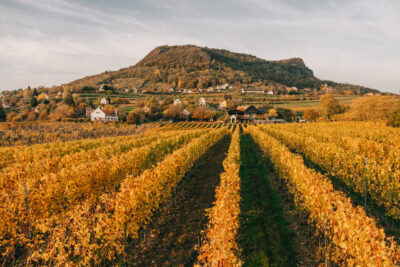 Badacsony is geologically unambiguous. The Badacsony Hill is an extinct volcano, and its vineyards are predominantly rooted in weathered basalt. These soils are well drained, retain heat efficiently and are comparatively rich in minerals and potassium – factors that manifest less in aroma than in structure.
Potassium plays a decisive role in the must, promoting the precipitation of tartaric acid and thus contributing to higher pH levels. In combination with Kéknyelű’s naturally firm acid profile, this creates a distinctive equilibrium: acidity that is ripe and supportive rather than sharp, allied to a supple, textural mouthfeel. The result is not softness, but a different form of balance – less angularity, more volume and a composed, linear progression.
For Kéknyelű, basalt does not amplify primary fruit; it focuses texture. Salinity, phenolic grip and a faintly oily tactility come to the fore, while fruit expression remains deliberately restrained. The volcanic substrate acts as an organising force rather than a flavour marker.
Late ripening, narrow margins – the 2024 vintage
The 2024 vintage tested this balance to an extreme. Heat and drought necessitated an unusually early harvest in order to preserve freshness and structure without sacrificing flavour maturity. At Szászi Birtok, Kéknyelű was picked on 12 September – the earliest harvest date ever recorded for the variety at the estate, yet still the final picking of the vintage. The timing illustrates how narrow the decision window for Kéknyelű has become.
Ageing potential is strongly vintage-dependent. Wines from warmer years tend to evolve more quickly, often reaching their drinking window earlier; for these, consumption within one to five years is generally advised. The most complete and long-lived expressions, however, arise from more balanced seasons with moderate temperatures and favourable rainfall distribution. At Szászi, 2023, 2021, 2019 and 2017 stand out as exemplary vintages.
Structure in the glass – consequence, not effect
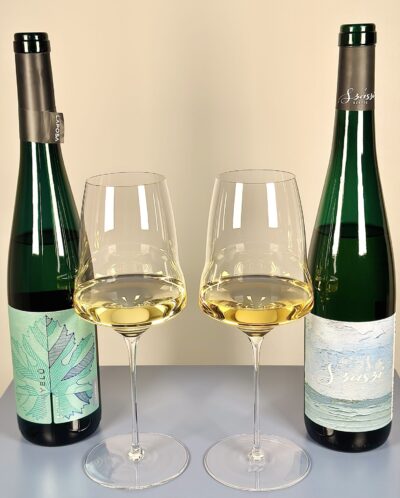
The tasting confirms these relationships. Both wines were assessed from Josephinenhütte Universal Glasses, at approximately 11 °C, after being opened one hour prior to tasting.
2023 Laposa Kéknyelű Badacsonyi
Pale lemon in colour. Initially restrained on the nose, more quiet than expressive. Subtle notes of green apple and apple skin are joined by hints of honey, kumquat and flint. Aromatically elusive – lightly scented to almost neutral – a faithful reflection of the variety.
The wine finds its voice on the palate. Density and a finely oily texture take centre stage, without any sense of weight. A clear saline line runs through the wine, supported by well-integrated, carrying acidity. This is not a wine defined by aromatic complexity, but by structure and texture. More character than complexity – and therein lies its strength.
2024 Szászi Kéknyelű Badacsonyi (organic)
Hand-harvested, spontaneously fermented in stainless steel tanks, then matured for three months in 500-litre Hungarian oak barrels (one to two years old).
Medium gold in colour. Smoky nuances and a fine struck-match reduction initially frame the wine, gradually revealing notes of blossom, pear and pear skin, quince, Amalfi lemon and nashi pear. A distinct saffron note stands out, accompanied by hints of freshly churned butter, salted caramel and a touch of vanilla.
On the palate, texture again defines the wine. Acidity is not the principal driver; length is generated instead by a fine phenolic bitterness that provides grip and tension. Salinity and bitterness interlock, joined over time by nuances of Darjeeling tea and a suggestion of green pineapple. The finish is long and composed, marked by inner calm. A wine that speaks softly, yet with conviction – and an excellent partner to roasted vegetables.
Where theory gives way
Kéknyelű is not shaped by primary fruit, but by structure, texture and place. It demands patience – in the vineyard and in the glass. And it is precisely this restraint that defines its contemporary relevance.
My sincere thanks go to Friedrich Dániel and the team at Szászi Birtok for their detailed and thoughtful responses, as well as for providing the photographic material, which together offered valuable insight into the viticulture, vintage conditions and ageing behaviour of Kéknyelű.