
From Workhorse to Cult Wine
The story of Chenin Blanc in South Africa begins not with great wines, but with utility. For decades, Chenin was rarely considered a wine in the cultural sense, but rather a solution to a problem seldom articulated. The name Chenin Blanc itself carried little weight; at the Cape it was simply known as Steen – a term defined less by origin than by function: a grape that reliably delivered high yields, stable acidity and consistency in a warm climate, equally suited to distillation, base wine and volume production. Chenin formed the backbone of a system built on function rather than origin – and for that very reason remained largely invisible.
That Steen and Chenin Blanc are identical was only conclusively established in the mid-twentieth century. By then, the variety had long been entrenched as a utilitarian workhorse. Its adaptability was never a sensory promise of quality, but above all an advantage in yield, stability and economic predictability. Chenin was used, not questioned.
This becomes particularly evident in its role as a central grape within South African brandy production. For decades, Steen served as a principal base for distillates: high-yielding, acid-stable and technically predictable. Traits that proved useful in the production of simple, volume-driven wines were ideal for the still. The result was almost inevitable: where a grape is regarded primarily as raw material, little interest develops in origin, texture or expression. Chenin was present – but rarely intended.
Why this perception endured for so long can also be explained through market logic. As Hendrik Thoma MS has observed, Chenin Blanc fitted perfectly into a business model built on volume and reliability. Wines such as Lieberstein succeeded precisely because they did not need to be “special”; they simply had to function. With the growing influence of Anglophone markets, the parameters shifted: internationally legible varieties such as Chardonnay or Sauvignon Blanc were easier to position. Chenin remained present, yet increasingly carried the aftertaste of anonymity.
Only after 1994 did this perception begin to change slowly. A new generation of winemakers – often indirectly – reconnected with something that had always existed: old vineyards and established Chenin plantings that had adapted over generations to climate and soil. That this substance remained accessible was no coincidence, but also the result of Rosa Kruger’s decades-long work in identifying, assessing and preserving old vines from disappearance. Her efforts, later consolidated within the Old Vine Project, created the conditions that allowed this generation to encounter tangible substance in the vineyard rather than searching for it in abstraction.
The distinct identity of South African Chenin today owes much to the fact that it evolved independently of the Loire over centuries – not through genetic divergence, but through a unique expression shaped by climate, use and selection. In some respects, its trajectory recalls certain Atlantic island wines – not stylistically, but historically: long shaped by pragmatic use, free from ideological expectation, and locally formed over generations before receiving serious qualitative attention. The modern revival therefore represents less a sudden beginning than the rediscovery of substance that had long been present but rarely acknowledged.
The paradox is that this prolonged phase of functional overuse created the very conditions for what we now celebrate as great South African Chenins. As markets shifted, as volume lost value and old vineyards became a burden, something remained that had previously gone unnoticed: vines too old to be efficient – and precisely for that reason, suddenly compelling.
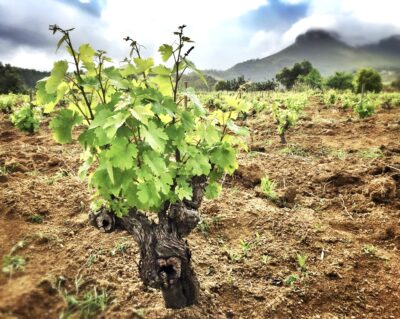 Old Chenin vines are uncooperative – and therein lies their value. They do not yield homogeneous musts, resist standardisation and produce less juice, often with significant phenolic density. For industrial processes, this is a flaw. For attentive growers, it is a signal. Not because greatness is guaranteed, but because shortcuts cease to exist.
One vineyard in which this evolution can be read with particular clarity is Mev. Kirsten in the Jonkershoek Valley near Stellenbosch. The oldest vines date back to a time when Chenin Blanc at the Cape was hardly conceived as a terroir wine – and yet it is precisely this history that defines the site today. Because the vineyard brings together plantings from different decades – all massal selections rooted in heavy, clay-rich soils – ripening tends to unfold as a spectrum rather than a single point. The task in the cellar is not to smooth this diversity into uniformity, but to interpret it and find balance. As Eben Sadie puts it: “It is always about balance rather than precision.”
Out of this complexity emerges a wine that feels both powerful and suspended – density without heaviness, energy without volume. The soils provide structure, yet the wine seems to rise beyond their weight, carried by an inner tension that resists explanation more than it invites it. Mev. Kirsten is therefore not a model to be replicated, but an exception: a place whose greatness lies not in perfection, but in its ability to translate diversity into a quiet, almost weightless equilibrium.
This balance is not a stylistic gesture, but a structural consequence expressed in the glass. Mev. Kirsten is neither a loud wine nor a closed one. It does not seek the easy charm of primary fruit, but builds presence through texture, salinity and inner density. In youth it often appears restrained and focused, opening gradually with air and time: citrus freshness, yellow-fruited nuances, fine phenolic grip and a precise, supporting acidity increasingly intertwine. It is a Chenin that speaks less through overt aromatics than through structure – and for that reason gains complexity over years, not through volume, but through the growing integration of its elements.
Here the arc of the grape’s history comes full circle: this wine is not a counterpoint to the past, but its delayed result. Without decades of use, without yield pressure and without functional overburden, it would not exist. The path from workhorse to cult wine is not a classic ascent, but a shift in scale. Less quantity. Less intervention. Less security. More risk.
South African Chenin Blanc does not stand in the shadow of the Loire; it evolves from different conditions – a history of use rather than classification, old vines rather than stylistic expectation, and a landscape that has shaped it differently over generations. Out of this origin emerges a wine defined by limitation: shaped by old vines, water stress, low juice yield and the willingness to leave edges intact. Cult status here arises not from style, but from restraint.
Perhaps therein lies the true lesson of this variety: Chenin Blanc was only truly recognised once it ceased to be merely useful – and was finally taken seriously.
My thanks go to Eben Sadie for his time, for answering my questions, and for kindly providing the photograph, as well as to Hendrik Thoma MS for his thoughtful insights and perspective.
Further reading:
– Chenin Blanc Association South Africa – History of Chenin