
Bernkasteler Doctor: How Great Sites Become Great Origins
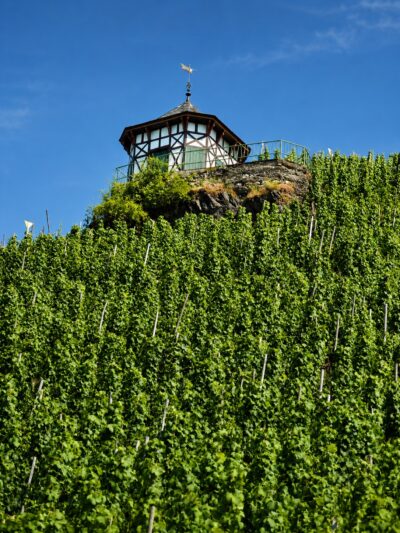 Bernkasteler Doctor is widely regarded as one of the great vineyards of the Mosel. The more interesting question is: why this particular site?
A little over three hectares of steep vineyard above the town of Bernkastel, directly overlooking its rooftops. South to south west facing. Devonian slate. At first glance, much of this sounds familiar. Similar conditions can be found in many of the Mosel’s other great vineyards.
And yet, whenever the conversation turns to the region’s greatest wines, Doctor seems to appear again and again.
Rather than an exception, Bernkasteler Doctor may be one of the clearest examples of how origin takes shape. Not through geology or slope alone, but through the interaction of place, human intervention, accumulated experience, market recognition and legal protection.
The Place
Much of what makes the Doctor distinctive appears to be rooted in the site itself.
The vineyard receives sunlight well into the evening, while its open position above the Mosel Valley promotes constant airflow. Moisture tends to dissipate relatively quickly, reducing disease pressure compared with more sheltered locations lower in the valley.
The grey-blue Devonian weathered slate, together with its fine earth and clay components, is not merely the vineyard’s foundation but an active part of the system. It warms rapidly, stores heat and releases it gradually over time. In cooler vintages or during extended ripening periods, this effect can have a stabilising influence. Equally important is the structure of the soils themselves. The fractured slate layers are capable of retaining water at depth and making it available to the vines during drier periods.
This comparatively balanced water supply has given rise to various explanations over the years. Some accounts attribute it to underground springs beneath the vineyard. A more likely explanation lies in the combination of slate structure, slope and deep rooting, which together provide a degree of stability in the vine’s access to water.
The vineyard’s proximity to the town may also be significant. Stone buildings and traditional slate roofs absorb heat during the day and release it slowly after sunset. Their precise influence is difficult to measure in isolation, but they probably form part of the subtle microclimatic mosaic that has shaped the Doctor for centuries.
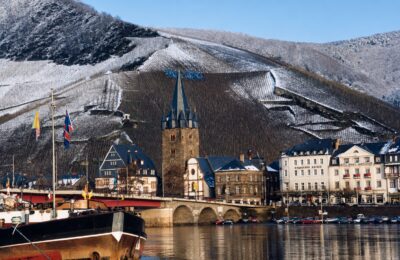 Historical accounts repeatedly note that snow tends to disappear from the Doctor earlier than from neighbouring areas. Such observations are no substitute for climate data. They do, however, suggest that the vineyard’s distinctive warmth and ripening dynamics were recognised not only through analysis but also through generations of practical experience.
There is another factor that is easily overlooked: the comparatively high proportion of old vines within the Doctor. Their root systems penetrate deep into the slate. Vines of this kind often respond less dramatically to short term weather extremes because they are able to access water and nutrient reserves from deeper soil layers.
Planting density is another important element. In parts of the Doctor, row spacing is as little as one metre. Mechanisation is therefore all but impossible and much of the work must be carried out by hand. The result is an exceptionally labour intensive vineyard. Competition between the vines may also contribute to a style of concentration that expresses itself less through sheer richness than through tension and precision.
It is impossible to isolate the precise contribution of any single factor. What seems more significant is the way they interact. In the Doctor, many of the defining conditions of the Mosel appear to come together with unusual harmony.
The Intervention
Along the Mosel, great vineyards are often spoken of as though they simply exist. The Doctor suggests that this is only part of the story.
During the eighteenth century, the vineyard was not merely cultivated but actively shaped. Historical records describe how rock was worked, slate was brought in and plantings were systematically adjusted. At the same time, Riesling increasingly established itself as the defining variety.
Some local traditions even suggest that slate from other wine regions may have been deliberately introduced into the Doctor during earlier phases of vineyard development. Such claims are difficult to verify with certainty today. Even so, the idea is an intriguing one, because it presents the vineyard not as an untouched natural landscape but as a cultural landscape shaped over centuries.
Origin here appears to emerge not despite these interventions, but partly because of them. A vineyard is not simply discovered; it is refined over generations. Great sites may emerge where natural conditions are read and shaped with unusual precision over long periods of time.
Experience
Early accounts rarely single out the Doctor because of individual great wines. What matters instead is comparison. Again and again, historical sources refer to healthy, fully ripened fruit, higher must weights and a lower susceptibility to rot. Even in more challenging vintages, the site is repeatedly described as exceptionally reliable in achieving ripeness.
What stands out is not any single observation, but the consistency with which those observations recur over long periods of time. The Doctor appears again and again in accounts of difficult vintages as a site capable of delivering dependable results.
More recent assessments from growers point in the same direction. Christina Thanisch has described difficult years as precisely those in which the Doctor’s qualities become most apparent. In warm and uncomplicated vintages, many top sites are capable of producing outstanding wines. Under more demanding conditions, the differences become easier to see.
The historical record is supported by analytical evidence. During the legal disputes surrounding the Doctor in the 1970s, comparative measurements were carried out over several years. Must weights from Doctor parcels consistently exceeded those of neighbouring top sites.
Certain vintages later reinforced this perception. In 1921, the Doctor produced the Trockenbeerenauslese from Wwe. Dr. H. Thanisch that would become one of the most legendary wines in German wine history. In 1959, a Doctor wine from the same estate reached 359° Oechsle, at the time one of the highest must weights ever recorded in Germany.
Such vintages alone do not explain the vineyard’s reputation. Rather, they concentrate into a single moment qualities that had long been associated with the Doctor: an unusual synthesis of ripeness, precision and inner tension, particularly under demanding conditions. From this emerges the interplay of power and finesse that so often characterises great Doctor wines.
Young Doctor wines frequently appear more restrained than expressive, marked by cool tension, delicate smokiness and a sense of precision that communicates itself less through volume than through composure. Cooler vintages often seem to reveal this character most clearly. They lend the wines additional drive while preserving the freshness that allows great ripeness to remain balanced.
This capacity for development is not limited to the sweet wines. Dry Doctor wines, too, often gain considerable depth and cohesion with age. Many appear almost reserved in youth and reveal their true tension only over time.
Perhaps this is one of the Doctor’s defining qualities: not the production of occasional extraordinary vintages, but the ability to produce remarkably precise and compelling wines even under more difficult conditions.
The Market
For a long time, a vineyard’s reputation remains largely local. Only when wines begin to be compared, discussed and valued more highly than others does origin become visible beyond its immediate region.
The great wine auctions make this process particularly clear. Wines are tasted side by side, compared directly and assigned a market value. Opinions emerge through discussion, prices through competition. In Trier, Koblenz and Bernkastel, differences between individual vineyards become publicly visible and economically measurable.
It was in this environment that a hierarchy of sites gradually began to take shape. The Prussian vineyard classification map of 1868 already singled out certain Mosel vineyards and attributed particular value to them. With the founding of the Mosel Winegrowers’ Association in 1899, such distinctions moved further into public view. Some sites increasingly came to be regarded as especially valuable, while others lost standing. This was not yet a classification system in the modern sense, but it was already an attempt to compare and evaluate sites more systematically.
From an early stage, the Doctor was among the sites that helped define this emerging hierarchy.
Its economic significance became apparent remarkably early. By the turn of the twentieth century, Doctor wines were being traded as wines of exceptional value far beyond the Mosel. On the wine lists of leading hotels, they sometimes appeared at higher prices than renowned Bordeaux wines. The name was found not only at the English royal court but also at state banquets. It was no longer recognised merely at a regional level, but had become an internationally traded mark of quality.
What matters here is not the record price itself, but the fact that the vineyard’s reputation was repeatedly confirmed by the market. The Doctor was not merely described and praised. Over decades, it was valued more highly, traded at higher prices and sought after internationally. Its standing was not simply asserted; it proved itself repeatedly in the marketplace.
Narrative and Protection
As the Doctor became better known, its story spread far beyond the Mosel.
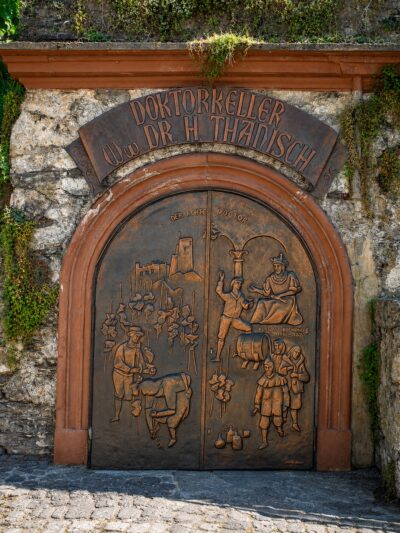 The well known story of the ailing Elector who was restored to health remained more than a piece of local folklore. It was retold in literature, depicted on labels and deliberately promoted. At a time when most buyers would never have seen the vineyard for themselves, the story gave the site a tangible presence.
The story does not explain the wine. It does, however, make the vineyard visible.
It did not create the Doctor’s reputation, but it helped make it easier to understand.
Growing recognition brought with it a new problem. Increasingly, the name began to appear beyond the boundaries of the vineyard itself. The resulting disputes eventually led to legal challenges.
The so called Doctor case of the 1970s centred on a deceptively simple question: what was entitled to bear the name “Doctor”? The dispute concerned not only the name itself, but also the question of where the historic vineyard actually ended.
In the course of the proceedings, it became clear that the Doctor’s reputation rested not on narrative alone. For decades, it had also been supported by demonstrable differences in quality. The final judgement reaffirmed the close connection between the name and the historically defined vineyard.
By now, it is clear that reputation must not only be built but also protected. A name loses its value once its boundaries become blurred.
Story and law serve different purposes. Together, they help ensure that place does not become arbitrary.
Why Some Places Endure
Bernkasteler Doctor is often described as one of the great vineyards of the Mosel. That is true, but it does not tell the whole story.
The Doctor is more than one of the Mosel’s great vineyards. It is an unusually clear example of how great sites become great places.
It is a story shaped by place, experience, market recognition, reputation and the rare ability to produce wines that remain in the memory long after they have been tasted.
Perhaps that is why the Doctor has remained more than simply a famous vineyard. Over the centuries, it has become something close to a myth.
Acknowledgements
I am grateful to Christina Thanisch for her generous support during the preparation of this article, for sharing her perspective on the Bernkasteler Doctor, and for kindly providing the historical photograph of the vineyard covered in snow.